
Work, debt, and enough
What the Bible says about money
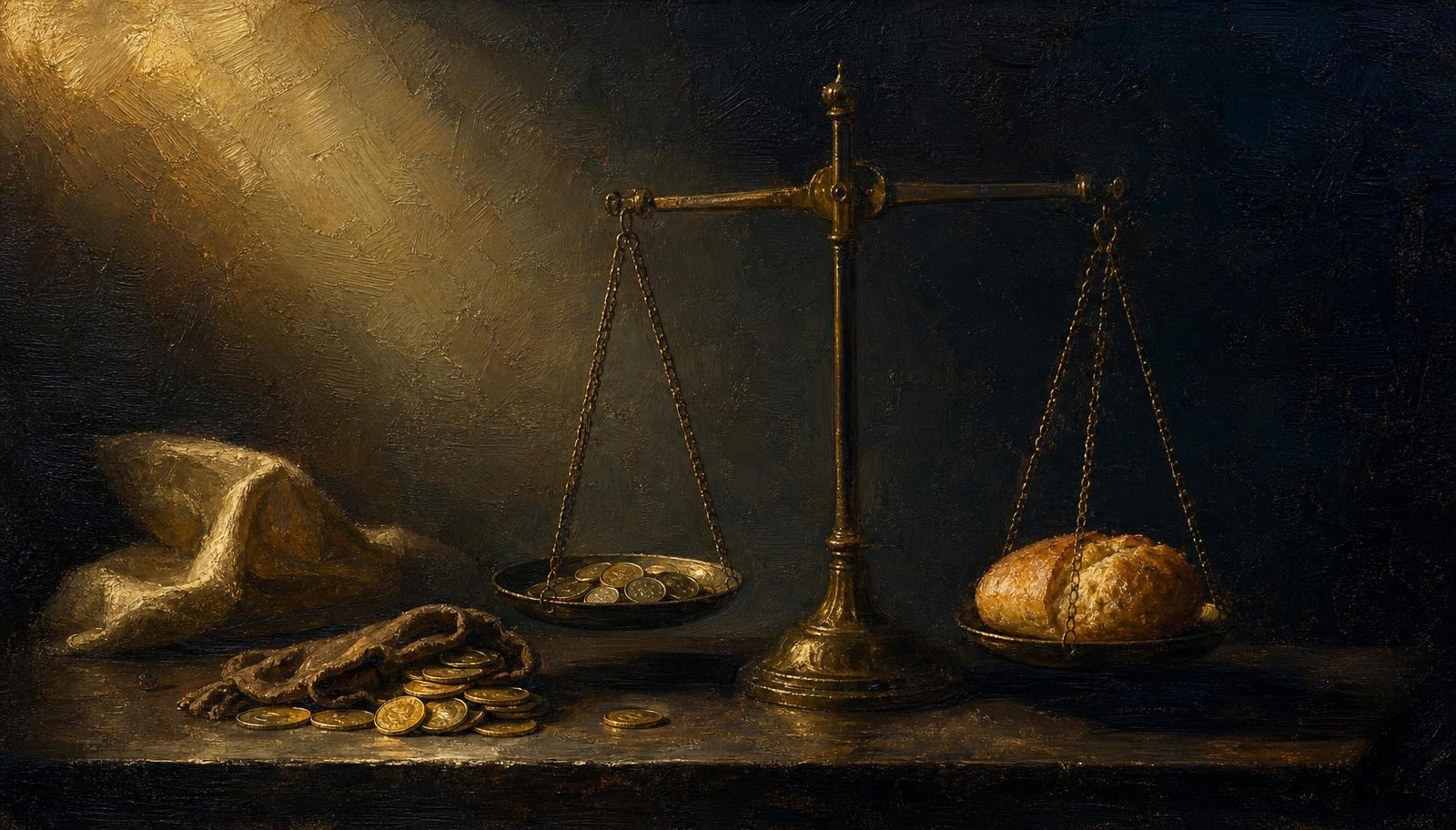
Jesus talked about money constantly — more than heaven, more than hell. Not because God needs it, but because what we do with money tells the truth about what we actually trust.
Scripture is neither anti-wealth nor prosperity-obsessed. It is relentlessly practical, and it is unimpressed by net worth.
Three consistent threads
First, money is a tool and a test, not a scorecard. Second, the love of money is the danger, not the money itself — Scripture has wealthy faithful people in it and poor faithless ones. Third, generosity is treated as the antidote, and it is talked about with joy rather than obligation.
Anyone who tells you God guarantees financial return on your giving is selling something. Scripture promises provision and contentment, not returns.
Passages, in context
Berean Standard Bible · public domain
1 Timothy 6:9-10
Those who want to be rich, however, fall into temptation and become ensnared by many foolish and harmful desires that plunge them into ruin and destruction. For the love of money is the root of all kinds of evil. By craving it, some have wandered away from the faith and pierced themselves with many sorrows.
The famous line is misquoted. It is the love of money, not money, that is a root of all kinds of evil — and the warning is about craving, which can afflict anyone at any income.
Matthew 6:24
No one can serve two masters: Either he will hate the one and love the other, or he will be devoted to the one and despise the other. You cannot serve both God and money.
Jesus personifies money as a rival master. The claim is that money will try to run your life if you let it.
Hebrews 13:5
Keep your lives free from the love of money and be content with what you have, for God has said: “Never will I leave you, never will I forsake you.”
Contentment is tied directly to God's presence, not to an amount. 'I will never leave you' is offered as the cure for grasping.
Proverbs 22:7
The rich rule over the poor, and the borrower is slave to the lender.
The borrower is servant to the lender. A plain observation about how debt reshapes your freedom.
2 Corinthians 9:7
Each one should give what he has decided in his heart to give, not out of regret or compulsion. For God loves a cheerful giver.
Give as you decide in your heart, not under compulsion. The cheerful giver line is about freedom, not pressure.
Proverbs 3:9-10
Honor the LORD with your wealth and with the firstfruits of all your crops; then your barns will be filled with plenty, and your vats will overflow with new wine.
Honoring God with the firstfruits — the first portion, not the leftovers. The principle is priority, not percentage.
Luke 12:15
And He said to them, “Watch out! Guard yourselves against every form of greed, for one’s life does not consist in the abundance of his possessions.”
'Life does not consist in an abundance of possessions.' Jesus says this while refusing to settle an inheritance dispute.
Questions to sit with
- If someone looked at your last three months of spending, what would they say you love?
- What would 'enough' actually look like for you? Have you ever named a number?
- Is there someone you could quietly help this month?
Where this lands
The gospel takes the pressure off money because it settles the question money is usually trying to answer: am I secure, and am I worth something. Both were answered at the cross, and neither is up for renegotiation based on your balance.
Common questions
Does the Bible say money is the root of all evil?
No — that's a misquote. 1 Timothy 6:10 says the love of money is a root of all kinds of evil. The distinction matters: Scripture treats money as morally neutral and the craving for it as dangerous.
Does the Bible require tithing ten percent?
The tithe is an Old Testament command tied to Israel's law and temple system. The New Testament doesn't repeat the percentage; it calls for generous, regular, cheerful, planned giving. Many Christians use ten percent as a practical starting point rather than a rule.
Is it wrong to be rich?
No. Abraham, Job, Lydia, and Joseph of Arimathea were all wealthy and faithful. Scripture's warnings to the rich are severe but they are about hoarding, exploitation, and false security — not about the money itself.